
There was a time when lawmakers with opposing views would reach across party lines and work together to find solutions to shared concerns. In today’s climate, that almost sounds like a fairytale.
But it did happen. Shirley Chisholm was able to find a compromise with George Wallace that became deeply impactful in U.S. history.
Former Brooklyn schoolteacher Shirley Chisholm made history when she was elected to the House of Representatives in 1968, becoming the first Black woman in Congress. She was the only freshman woman elected to the 91st Congress and one of 11 female members.
In Anastasia Curwood’s book “Shirley Chisholm: Champion of Black Feminist Power Politics”, the author explores Chisholm’s political legacy and personal story. Curwood is a professor of history and director of the Commonwealth Institute for Black studies at the University of Kentucky.
“Shirley Chisholm was the first woman to run a nationwide campaign for the Democratic nomination for president of the United States and the first Black person to run on a major party ticket,” Curwood told WTOP. “She’s larger than life.”
Decades before former President Barack Obama, former Vice President Kamala Harris or former Secretary of State Hillary Clinton entered presidential politics, Chisholm was breaking the glass ceiling.
“Chisholm said, ‘You know the thing that has held me back in politics?’ And she was specific, she said: ‘In politics, it is more my sex than my race,” Curwood said.
Chisholm’s announcement was met with anger by some she believed were political allies and friends. Most notably, the Congressional Black Caucus.
“They said, wait a minute,” Curwood said. “We’ve been having these meetings try to decide if a Black man should run, and how can you jump ahead of us like that?”
While Chisholm’s campaign may have received lukewarm support from political insiders, she found strong backing from Black women, young people and college students, Curwood explained.
“They loved her because she just spoke the truth in a really plain way,” Curwood said.
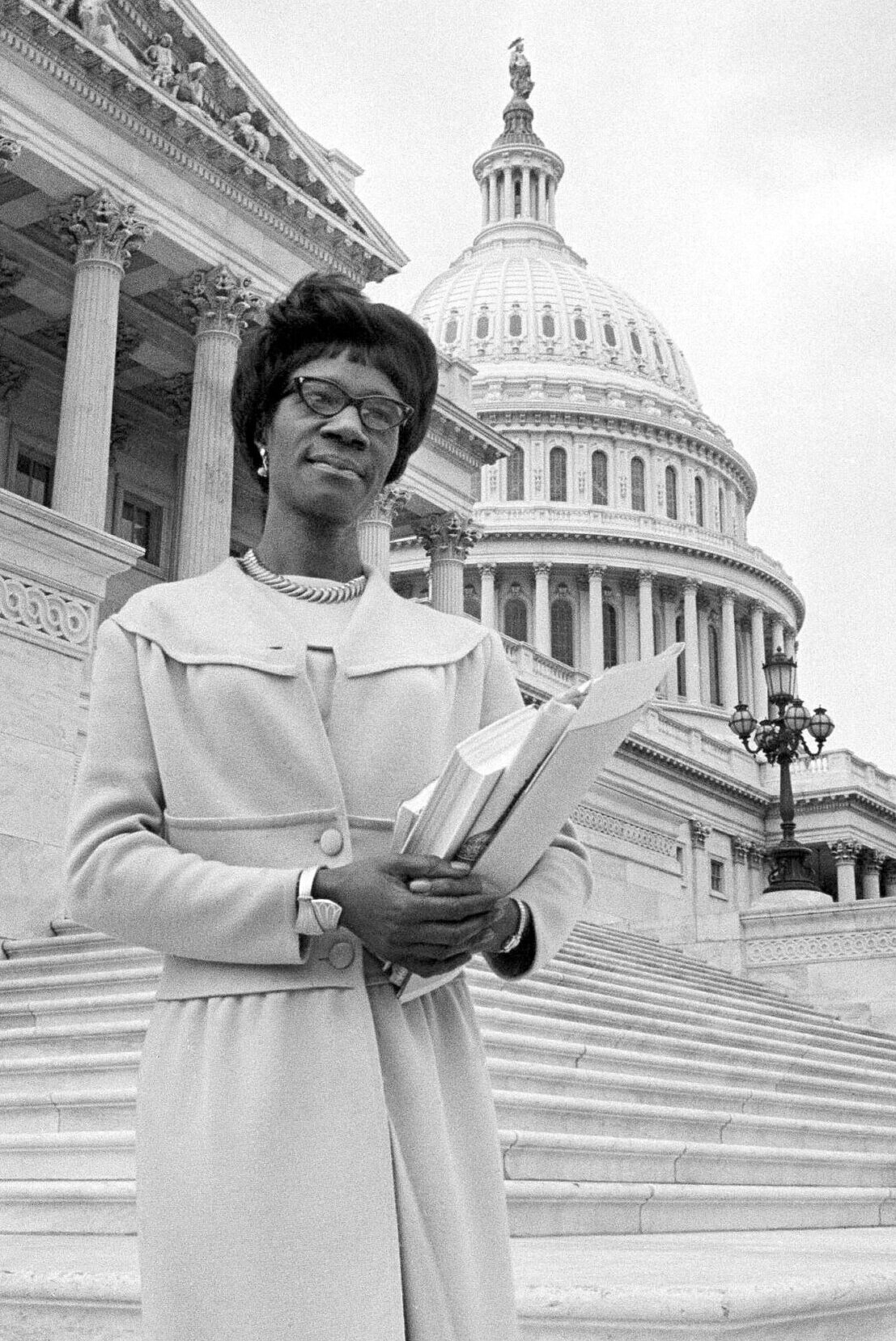
One of the benchmarks of Chisholm’s political career came during the 1972 Democratic primary campaign, when she shocked many observers by not only reaching across the aisle but also showing personal kindness to fellow presidential candidate Gov. George Wallace of Alabama.
After the segregationist was shot by 21-year-old Arthur Bremer during an outdoor rally at Laurel Shopping Center, he was hospitalized at Holy Cross Hospital in Silver Spring.
Wallace, who, less than 10 years earlier, delivered the infamous “segregation now, segregation tomorrow, and segregation forever” inaugural address, was visited in the hospital by Chisholm.
The visit was considered bold at the time and helped Chisholm with women voters, reinforcing her campaign slogan: “Unbought and Unbossed.”
The meeting with Wallace would matter again a year later when Chisholm needed to reach across the aisle once more.
“Chisholm tried to pass minimum wage protections for domestic workers, and who did she have making phone calls to Southern congressmen on her behalf?” Curwood asked. “George Wallace.”